The most useful Instagram content ideas for service businesses often begin with questions a prospective client already has. What work do you handle? What does the process involve? What should someone prepare before inquiring? A post that answers one of those questions has a clearer purpose than a format chosen only because it is fashionable.
This guide is for planning ongoing service content after the basic introduction is already clear. It does not promise a posting frequency that guarantees clients or a fixed set of “content pillars” every business must use. The proofreading example is fictional, and any real client material needs appropriate permission before it is shared.
Ask a Useful Question Before Choosing a Post Format
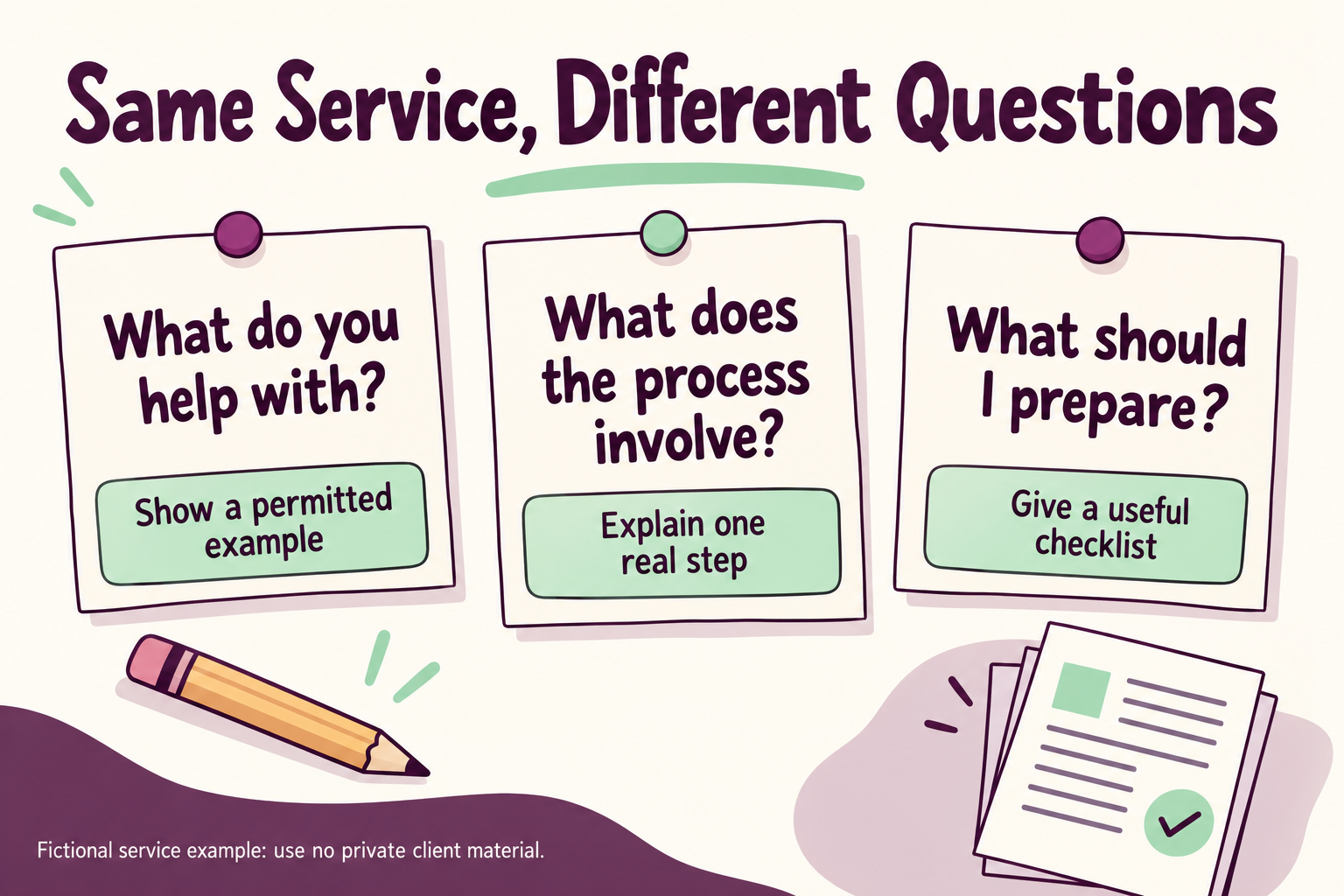
Collect the questions that genuinely come up around your work. They might concern fit, preparation, process, deliverables or boundaries. Do not publish a private message to prove a question exists; summarize the useful issue without identifying the person who asked.
Then decide what would make the answer understandable. A short explanation may be enough. A permitted example can help when the question concerns the work itself. A checklist is useful when a prospective client needs to prepare something before the first conversation.
| Buyer Question | Post Purpose | Boundary to Keep |
|---|---|---|
| What work do you handle? | Explain one actual service with a clear example. | Do not imply a broader offer. |
| What happens during the work? | Describe one real process step. | Keep client information private. |
| What should I prepare? | Give a short inquiry checklist. | Ask only for information needed at that stage. |
Preview’s business post-ideas guide includes questions, tutorials, examples and behind-the-scenes work. Those are possible vehicles for an answer, not a requirement to publish every type or buy a scheduling tool.
Use Before-and-After Examples Without Inventing Results
An example can show a decision or change without proving a business outcome. A proofreading sample may demonstrate a corrected sentence; it does not establish that the client gained customers. A designer’s revised layout can show hierarchy without claiming increased sales.
When You Do Not Have Client Work to Share
Create a clearly labeled demonstration using material you own or are permitted to use. For a fictional proofreader, a short self-written paragraph can show the type of changes included in a service. Explain the scope: a correction of punctuation is not evidence of a complete editorial rewrite, fact check or legal review.
Do not invent a testimonial to accompany the demonstration. If an example uses real work, check disclosure and credit requirements first. The graphic-designer caption guide gives a related way to distinguish an actual contribution from an unsupported result.
Turn Behind-the-Scenes Work Into an Explanation
A desk photograph becomes useful when it explains a real part of the service. Show the purpose of a checklist, how you organize a handoff or what information you need before starting. A screen full of private documents is not necessary to demonstrate that the work exists.
For the fictional proofreader, a post might explain why the client supplies the intended audience and final file format before a quote is discussed. That information affects the conversation; it is more instructive than a generic image announcing a busy day.
Preview’s caption-writing guide asks what you want a reader to take away from a post. Use that question to decide what the behind-the-scenes image needs to explain. Avoid replacing a useful point with a manufactured story about productivity or expertise.
Plan a Small Set of Posts You Can Sustain
Choose a realistic number of useful answers for the time and material you actually have. Not every business needs the same weekly rhythm, and more posts do not automatically make the answers better. Leave room to respond when a new question deserves attention.
A Proofreader’s Four-Post Sequence
A fictional sequence could begin with a clearly labeled editing sample, follow with an explanation of what the service includes, then show an inquiry-preparation checklist and answer one common scope question. These are four different reader jobs, not the same offer repeated under four decorative headlines.
Before making the sequence public, check that each post supports the current service page. If the invitation leads through your profile, the bio-link activity guide explains what the resulting link observations can and cannot tell you. Do not attribute a sale or a specific person’s interest to a few taps.
Keep a short note after each post: what question did it answer, did the destination match, and what useful follow-up arose? That produces a more grounded next plan than copying an arbitrary calendar of themes.
Related reading: if a public question deserves a stable, visible answer, the guide to pinning an Instagram comment explains that separate platform task. Use a useful public answer, not a client’s private details, and keep it consistent with the current service information.