
Customer reviews on Instagram are most useful when someone can understand what the customer actually experienced. Choose genuine feedback, check the words against the original, agree on how it may be shared and explain the relevant product or service. A glowing quote should not become a claim broader than the experience behind it.
This is an editorial workflow, not legal advice or a promise that a testimonial will increase sales. The stationery-shop example below is fictional and demonstrates a writing decision; it is not a review from a real customer. If you do not have suitable feedback to share, show your own work instead of inventing a customer.
Choose Customer Reviews That Answer a Real Question
Begin with the uncertainty the post could help resolve. A buyer might want to know whether a notebook lies flat, what a project handoff includes or how an item was packaged. A specific experience gives that person more to consider than a row of stars detached from the purchase.
Do not select a quote only because it sounds dramatic. Make sure you can identify the relevant order or service privately and explain the connection accurately. Keep order numbers, addresses and private contact details out of the public post.
Preview’s business post-ideas guide describes reviews as either a quote in the image or feedback in the caption. That is a useful presentation choice. It does not remove the need to check permission, preserve context or distinguish an individual experience from a general promise.
Check the Customer Review and Its Context
Compare the proposed wording with the original feedback. Do not quietly turn “the package looked lovely” into “the product was perfect.” If you shorten a review, preserve its meaning and make any omission clear where it matters. Correcting the customer’s words into a stronger endorsement creates a different statement.
In a fictional stationery example, a customer says that the wrapping kept a notebook neat when it arrived. The post could describe that one packaging experience. It could not truthfully say every order arrives damage-free, or that the customer praised the paper quality when the comment never mentioned it.
Also check which product version the feedback concerns. A review of an older binding should not appear to describe a newly redesigned notebook without explanation. If an accurate explanation makes the quote too complicated to use, choose another example rather than stripping away the important qualification.
Ask Before Posting Customer Reviews on Instagram
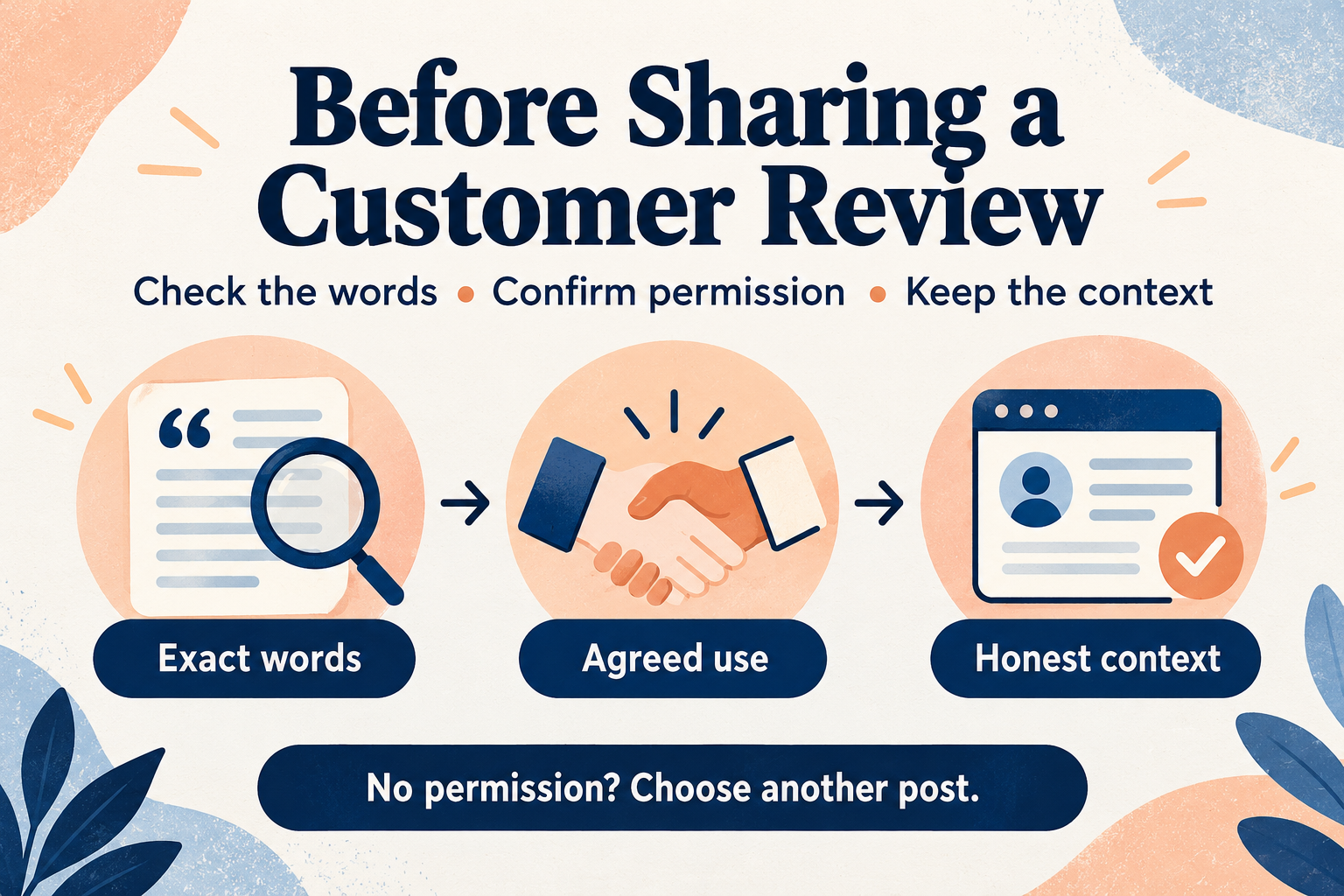
A private message is a conversation, not an automatic invitation to create an advertisement from it. Ask about the exact excerpt, the intended public account and whether the person wants a name, handle, photograph or identifying detail included. Keep the agreement with your own records.
A practical request might explain that you would like to quote a particular sentence in a public Instagram post, then ask whether the person is comfortable with the wording and attribution. Do not pressure them or treat silence as agreement. Permission to use a sentence does not necessarily cover the entire screenshot or a photograph.
Cropping an avatar or hiding a username can reduce exposure, but it does not settle whether the words may be shared. The related tagged-photo guide concerns a separate profile control; a visible tag is not a substitute for agreeing on the use of someone’s feedback.
Make the Review Readable Without Hiding the Details
Use a short excerpt large enough to read on a phone. Put context beside it in ordinary text: what the person bought, which service they used and any limitation needed to understand the experience. Do not squeeze a full conversation into a tiny decorative card.
Retyping an agreed quote can be clearer than posting a screenshot full of private details. Check the transcription carefully and avoid visual additions that imply a rating the customer never supplied. A five-star icon is still a claim when nobody gave five stars.
If important words live inside a graphic, make them available in accessible text too. Our alt-text guide explains the image-description task. Keep the quote faithful in both places rather than describing the card only as “happy customer feedback.”
Write a Caption That Gives Customer Reviews Context
The caption can explain the specific experience without repeating the entire graphic. For the fictional notebook example, it would identify the packaging detail and describe the current product accurately. It should not turn a single delivery into a guarantee about future shipments.
Preview’s caption-writing guide recommends deciding what one message the reader should take away. Here that message is the useful detail supported by the actual review. Skip unsupported outcome claims, exaggerated praise and an unrelated list of requests to follow, share and buy.
Before posting, check the quote, attribution, context, image description and destination together. If a later product change makes the post misleading, add an accurate explanation or stop using it in current promotion. Related reading: organizing multiple bio links helps when the review points readers toward a current product page rather than an outdated offer.